AnyConnect VPN: What It Is, How to Download, and How to Connect
Learn what AnyConnect VPN does, how to get Cisco Secure Client, and how to connect safely through your organization.
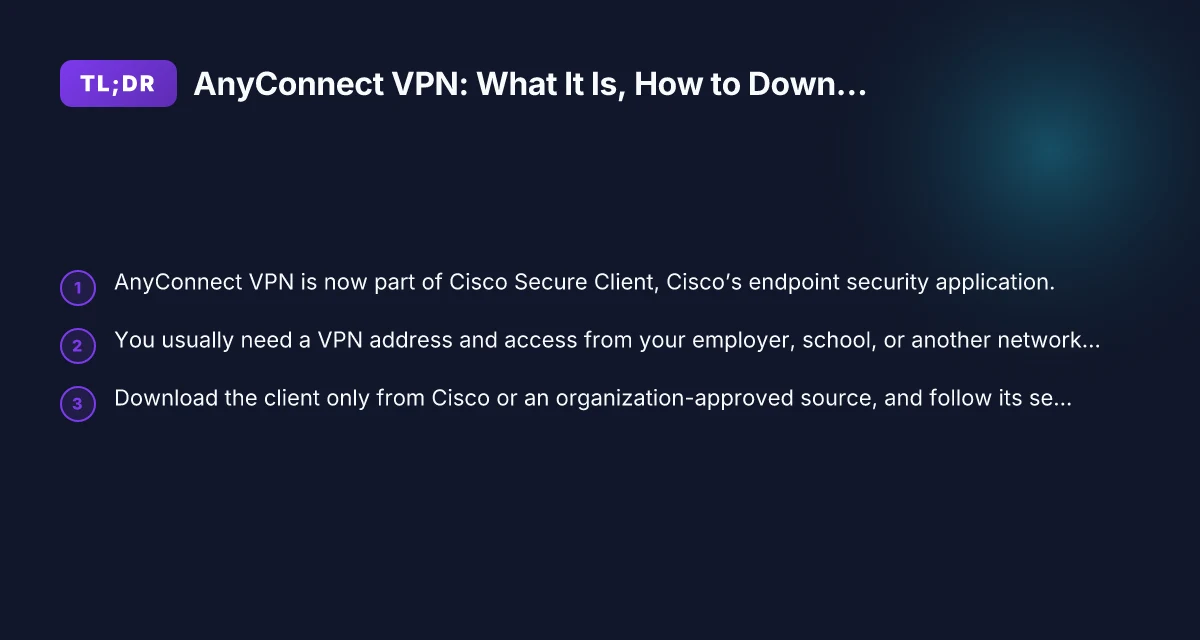
AnyConnect VPN is Cisco’s client for connecting securely to a workplace, school, or other private network over the internet. The product is now included in Cisco Secure Client, previously known as Cisco AnyConnect Secure Mobility Client. To connect, install the version your organization recommends, enter its VPN address, and sign in with the credentials and verification method it requires.

Editor's pick: NordVPN — fast, secure VPN — Strong encryption, a no-logs policy and apps for every device. 30-day money-back guarantee. Get NordVPN →
Compare VPN client options
| Option | What it is | Typical access | Cost | Best suited for |
|---|---|---|---|---|
| AnyConnect VPN | Cisco VPN client | Organization-provided VPN | Often requires a license | Existing AnyConnect users |
| Cisco Secure Client | Successor client to AnyConnect | Organization-provided VPN | Depends on organization license | Users moving to Cisco’s newer client |
| Built-in operating system VPN | VPN feature included with some devices | Compatible VPN service | Usually included with the operating system | Basic connections to supported VPNs |
| Browser-based access | Access to services through a web browser | Organization-enabled web portal | Depends on the service | Access without installing a VPN client |
| Third-party VPN app | Consumer or business VPN service | Provider account and app | Often subscription-based | Personal or business VPN needs |
| No VPN | Direct internet connection | No VPN account needed | No VPN client cost | Services that do not require private network access |
Compiled November 2026; check the provider's site for current details.
| VPN | Obfuscation | From / month | Plan | Free plan | Refund | Alipay | UnionPay | Crypto | Website opens in China | Trustpilot | |
|---|---|---|---|---|---|---|---|---|---|---|---|
 ZoogVPN | Turn on manually Shadow | $2.49/mo | 27 months: $59.99 | Yes | 7 days | ✓ | ✓ | ✓ | ✓ | Official site blocked; our special link opens (4.4 s) | 4.2/5 (195 reviews) |
 NordVPN | Turn on manually Obfuscated Servers / NordWhisper | $3.49/mo | 27 months: $94.23 | No | 30 days | ? | ✗ | ✓ | ✓ | ✗ Blocked | 4.2/5 (51,628 reviews) |
 ExpressVPN | ✓ On by default all servers | $3.00/mo | 28 months: $84 | No | 30 days | ✗ | ✗ | ✓ | ✗ | ✗ Blocked | 4.4/5 (29,706 reviews) |
 Surfshark | ✓ On by default Camouflage, with OpenVPN | See site | See site | No | 30 days | ✗ | ✗ | ✗ | ✓ | ✗ Blocked | 4.3/5 (31,823 reviews) |
 Proton VPN | Turn on manually Stealth, free plan too | $2.99/mo | 12 months: $35.88 | Yes | 30 days | ✗ | ✗ | ✗ | ✓ | ✗ Blocked | 2.1/5 (1,040 reviews) |
 Astrill VPN | Turn on manually StealthVPN / OpenWeb | $12.50/mo | 24 months: $300 | No | See site | ✗ | ✗ | ✗ | ✓ | ✗ Blocked | 1.3/5 (110 reviews) |
 Private Internet Access | Turn on manually Shadowsocks, OpenVPN only | $2.03/mo | 40 months: $81.2 | No | 30 days | ✗ | ✗ | ✗ | ✗ | ✗ Blocked | 4.2/5 (11,033 reviews) |
 CyberGhost | Turn on manually selected servers | $2.19/mo | 28 months: $61.32 | No | 45 days | ✗ | ✗ | ✗ | ✓ | ✗ Blocked | 4.0/5 (24,178 reviews) |
 PureVPN | Turn on manually switch to OpenVPN | $1.69/mo | 60 months: $101.55 | No | 31 days | ? | ? | ✗ | ✓ | ✗ Blocked | 4.4/5 (17,994 reviews) |
 AdGuard VPN | ✓ On by default TrustTunnel | $2.99/mo | 24 months: $71.76 | Yes | 30 days | ✓ | ✗ | ✓ | ✓ | Official site blocked; our special link opens (3.7 s) | 4.3/5 (290 reviews) |
 Mullvad | Turn on manually QUIC / Shadowsocks / LWO | $5.61/mo | €5/mo | No | 14 days | ✗ | ✗ | ✗ | ✓ | ✗ Blocked | 3.2/5 (192 reviews) |
 Windscribe | Turn on manually Stealth / WStunnel | $5.75/mo | 12 months: $69 | Yes | See site | ✗ | ✗ | ✗ | ✓ | ✗ Blocked | 4.7/5 (13,355 reviews) |
 StrongVPN | Turn on manually Scramble, OpenVPN TCP | See site | See site | No | 30 days | ✓ | ✗ | ✗ | ✗ | ✗ Blocked | 4.4/5 (2,695 reviews) |
 LightXtreme 闪连 | Not listed | $7.08/mo | 12 months: $84.99 | Yes | 30 days | ✓ | ✓ | ✓ | ✓ | ✓ Yes (3.5 s) | No page |
Prices checked 2026-11-10 on each vendor's pricing page (cheapest long plan, USD). Check the vendor's checkout for the final price.
Obfuscation checked 2026-11-14 on each vendor's site and help center: "on by default" = nothing to set; "turn on manually" = switch protocol or mode in settings; "not listed" = the vendor describes no obfuscation.
Payment methods checked 2026-11-10 on each vendor's payment pages: all 14 take cards and PayPal; ✗ = not listed, ? = the vendor's own pages disagree.
China access: whether the official website opens from mainland China networks (tests the website only, not the VPN connection). Last checked 2026-11-18 01:02 Beijing time.
Trustpilot score and review count checked 2026-11-10.
What is AnyConnect VPN?
A VPN, or virtual private network, creates an encrypted connection between your device and a network you are authorized to use. AnyConnect helps users access private network resources remotely, while IT teams can manage the client and related security capabilities.
Cisco currently presents the software as Cisco Secure Client (including AnyConnect). The older AnyConnect Secure Mobility Client v4.x is still listed in Cisco’s support information, but Cisco identifies it as a product that is supported and no longer being sold. For most new installations, follow your organization’s guidance on Cisco Secure Client rather than searching for an unofficial copy of the older client.
A VPN does not give you automatic access to every company or school network. The network owner must provide access and configure the connection.
Is AnyConnect VPN free?
The answer depends on what you mean by “free.” The client app may be available to download through an official app store or your organization’s software portal, but using it to reach a private VPN generally requires an organization to provide and authorize the service. 365Vpn Review: What to Know Before You Download
| Option | What it provides | What you may need |
|---|---|---|
| Cisco Secure Client app | The client software for a supported device | An organization-approved download source |
| Workplace or school VPN | Access to that organization’s private network | A VPN address, account, and any required sign-in verification |
| Unofficial download | A copy from a source that may not be verified | Avoid this; it may be outdated or unsafe |
The app itself is not a substitute for a VPN service or an access account. If you are unsure whether your organization provides access, ask its IT department before installing or attempting to connect.
Choose a download and setup route
| Situation | Where to get the client | What to check first | Who may need to help | Suitable choice |
|---|---|---|---|---|
| Employer or school provides VPN | Organization’s software portal | Approved client and device compatibility | IT administrator | Recommended route for managed access |
| Organization provides a download link | Link supplied by the organization | Link authenticity and installation instructions | IT administrator | Use the approved link |
| App is available through an official app store | Official app store for the device | Organization support and app compatibility | IT administrator if unsure | Convenient supported devices |
| Existing AnyConnect installation | Organization portal or IT guidance | Whether the organization still supports it | IT administrator | Keep it if directed |
| Moving to Cisco Secure Client | Organization’s approved source | Whether the VPN profile and services are supported | IT administrator | Use when the organization has migrated |
| Personal VPN use | VPN provider’s official site or app store | Provider reputation, plan, and device support | VPN provider | Choose a service matching personal needs |
Compiled November 2026; check the provider's site for current details.
How to download AnyConnect
The safest download source is the one named by your employer, school, or network administrator. Organizations may provide a specific version, installation page, VPN address, or setup guide. Free VPN Extension for Edge: What to Know Before You Install
Cisco’s product page identifies the current offering as Cisco Secure Client, including AnyConnect VPN. The application is also listed in official app marketplaces, including Apple’s App Store. A Windows listing for “AnyConnect” appears in the Microsoft Store, but its availability does not mean it will connect to your organization’s VPN without the correct service details and authorization.
Before downloading:
- Confirm which operating system and version your organization supports.
- Use the organization’s software portal or a link supplied by its IT team when available.
- Check that the publisher and app name match the official listing.
- Avoid third-party download sites and installers sent by unknown sources.
- Do not use old installation instructions unless your organization confirms they still apply.
Cisco Secure Client is listed as compatible with Windows, macOS, and Linux in some institutional software guidance. Availability and setup can vary by organization, device, and platform, so check local instructions first.
How to connect to AnyConnect VPN
The exact screens may differ by device and configuration, but the basic process is usually similar: F5 VPN Client: What It Is, How to Get It, and How to Connect
- Install Cisco Secure Client or the client version your organization specifies.
- Open the app and select the VPN option if it is not already displayed.
- Enter the VPN server address provided by your organization.
- Select Connect.
- Sign in with your authorized account and complete any required multifactor verification.
- Confirm that the client reports a successful connection before opening private network resources.
Some organizations use single sign-on or additional security checks. Others may require you to select a group or connection profile. Use the setup information provided by your organization rather than guessing at a server address or profile.
On Apple iOS, Cisco’s app listing notes that AnyConnect does not automatically connect by default; On-Demand or Per-App settings may be used. Whether those options are enabled depends on your organization’s configuration.
If you cannot connect
Check the common causes before trying repeated sign-ins:
- Incorrect VPN address: Verify the server name with your IT team.
- Account or password issue: Confirm that your account is active and that you are using the right credentials.
- Verification prompt not completed: Approve the requested sign-in or multifactor step.
- Outdated or wrong client: Ask which version your organization supports.
- Access not assigned: Contact the network administrator to confirm that your account is authorized.
- Connection or device restrictions: Check whether your organization requires a managed device or a specific network setup.
If the app displays an error message, note its wording and share it with IT support. Do not send your password or verification code to anyone. Radmin VPN: What It Does, How to Use It, and Is It Safe?
AnyConnect VPN versus Cisco Secure Client
The names can be confusing because Cisco’s current product branding includes both. In everyday use, people may still say “AnyConnect” when referring to the VPN feature, while Cisco’s product page uses Cisco Secure Client.
The key distinction is:
- AnyConnect VPN refers to the VPN functionality and the familiar client name.
- Cisco Secure Client is the current product name used for the client that includes AnyConnect VPN and supports broader endpoint security capabilities.
- AnyConnect Secure Mobility Client v4.x is an older product line that Cisco says is supported but no longer sold.
This naming does not change the basic requirement: you need a VPN service configured by an organization and permission to use it. Installing the app alone does not create access to a private network.
Connect and troubleshoot AnyConnect VPN What Is My IP Address NordVPN? How to Check Your Public and VPN IP
| Step or issue | What to do | What to check | If it does not work |
|---|---|---|---|
| Get the VPN address | Obtain it from your organization | Correct server or portal address | Ask IT for the approved address |
| Open the client | Launch AnyConnect | Client is installed and supported | Follow your organization’s installation guidance |
| Enter the server | Type the VPN address | Address spelling and connection type | Confirm the address with IT |
| Start the connection | Select Connect | Device has an internet connection | Try a permitted network or contact IT |
| Sign in | Enter organization credentials | Username, password, and any required authentication | Reset credentials or contact IT |
| Review security prompts | Follow organization instructions | Prompts are expected and legitimate | Stop and verify unexpected prompts |
| Confirm connection | Check the client’s status | It reports a connected state | Disconnect and retry, then contact IT |
| Disconnect | Select Disconnect when finished | Access to private resources ends | Close the client and ask IT if status is unclear |
Compiled November 2026; check the provider's site for current details.
Recommendation
For the most reliable setup, ask your employer or school for its current Cisco Secure Client instructions, approved download, VPN address, and sign-in requirements. Use that source rather than an unofficial installer or an outdated guide. If you only need a personal VPN and do not have access to an organization’s AnyConnect service, this client may not provide the VPN service you are looking for.